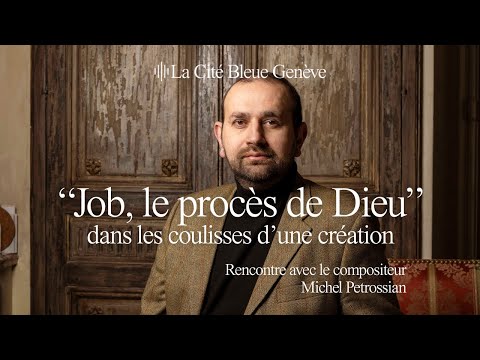
Job, le Procès de Dieu
What is, and what should be—the mind perceives the difference and names it: Evil.
The idea of unjust suffering, the events that make us fear the imminent end of a cycle, of a civilization, or simply of the world—these concerns recurrently lie at the heart of our questioning. Yet we may observe that this perception is as ancient as humanity itself. In The Dialogue of a Man with His Ba (known in Egypt since the Middle Kingdom), or in The Babylonian Poem of the Righteous Sufferer, the mystery of unjust suffering is addressed and identified as the emblem of a disorder inherent in the course of our world. In our civilization, the Book of Job is the place par excellence where this interrogation unfolds.
It was toward this book that I wished to turn when Leonardo García Alarcón approached me with the idea of a musical project in which music and text would come together in order to rediscover an aesthetic and ethical necessity through art. Whether considered a chamber opera, a piece of musical theatre, or a sacred drama, the work for which I wrote both libretto and music aims to revisit the subtle questions raised in the Book of Job, in the light of the recent tragic events of the war in Nagorno-Karabakh, as well as other dramas that challenge our relationship with others, with the environment, and with ourselves.
The libretto therefore intertwines a rewriting of the Book of Job with sung dialogues and eight contemporary texts (partly drawn from my book Chant d’Artsakh, © 2021 – Éditions de l’Aire, Vevey), which are theatricalized and recited.
The central thread is the terrible wager between God and Satan: does Job fear God for nothing, he who has been denied no grace? Two series of trials then begin. The first deprives Job of all his possessions and his children; the second strikes at his physical integrity and places him “in dust and ashes,” symbols of death.
“Curse God and die!” suggests Job’s wife—yet he refuses.
Three friends come to visit Job. Through three cycles of exchanges, increasingly brief and agitated, they first attempt to console him, then warn him, and finally accuse him. The underlying idea of their reasoning is simple: suffering cannot exist without fault, and through trial Job must humbly recognize his guilt.
“You are miserable comforters, masks of the devil,” Job finally declares.
For their compassion becomes yet another trial: the compassion of the self-righteous, secretly relieved not to suffer the same fate and intuitively convinced that they are more just, more aligned with divine expectations. The intervention of God at the end of the opera will deliver a sharp rebuke to them.
Thus Job refuses to be consoled, warned, or accused, because he experiences an inner paradox. He knows that retributive justice exists, yet he also knows that the logic of cause and effect does not apply in his case. Logically, this should imply divine injustice—but at first Job cannot bring himself to consider it. This is why he begins by cursing the day of his birth. As often happens, victims of the worst abuses or injustices initially seek the fault within themselves, the enormity of their suffering seeming too great to be attributed to chance.
The title Job, the Trial of God therefore carries a double meaning: the trial that God seems to bring against Job by exposing him to the blows of the Adversary, but also the trial that Job brings against God for having subjected him to such suffering.
The libretto then raises two questions—two “whys”—which in the original Hebrew of the Book of Job are expressed by two distinct words. There is the why of causality and the why of purpose. Why does Job suffer—for what reason? And for what end does Job suffer—for what purpose? (These passages are marked “to God” and are sung by Job and the chorus.)
Job and his friends search without finding an answer to the first why. Yet they are in fact responding to a question they were not asking—the why of causality. At the end of his trials, Job will change his perception:
“My ear had heard of you, but now my eye has seen you,” he says in his final dialogue with God.
When God finally appears, He seems to answer entirely beside the point, offering Job a lesson in astronomy and geology before presenting a kind of decalog of animals—ways of indicating to Job the limits of his knowledge and power. The ultimate divine response is the strange evocation of two cosmic creatures, Behemoth and Leviathan, interpreted in many ways by historical commentators and modern exegetes, who tend to see in them spiritual entities whose creation by God demonstrates His dominion over violence and disorder.
The opera is guided by the discreet gaze of Yemimah, Job’s daughter born after the catastrophes. She is present from the opening of the opera and reappears in the middle and at the end. The figure of the child opens toward the future: in a poetic gesture, the Old Testament reality and its contemporary reinterpretation converge here.
Despite the latent threat expressed by Job—
“This will not stop soon; it will begin again. No one will stop them, no one will comfort us”—
and its geopolitical realization in the Armenian case (the indigenous population of Nagorno-Karabakh was entirely expelled from its historical lands in 2022), it remains possible to continue living and to marvel at the world by recalling ancient beauties: the Shulamite of the Song of Songs, the cypress of Abarkuh, the oldest tree in Iran, and the reminder of primordial origins—“the first vine of Noah in the valley of Ararat.”
The vocal writing calls upon a wide range of registers, and each solo voice embodies a plurality of characters—or, in the case of the tenor, multiple faces of Job. To the five soloists are added three female voices functioning as a chorus, often reinforced by the participation of the soloists.
The instrumental ensemble draws inspiration from Sumerian and Babylonian configurations, which accompanied two types of singers: the Nar, who celebrated festive events and victories, and the Gal, dedicated to lamentation. In these orchestras, plucked strings (harps and lyres), double flutes, and various percussion instruments—often played by women—predominated.
To recreate the spirit of these ancient ensembles, I chose instruments evoking traditional, baroque, and contemporary worlds, seeking to build bridges between instrumental families sharing comparable functions or constructions. The qanûn, representing plucked strings, echoes the theorbo and guitar, as well as pizzicato strings; the flute and clarinet respond to the cornett, mute cornett, and recorder; percussion creates links between worlds, as does the accordion, which, belonging fully to none of them, incorporates them all.
Finally, the work unfolds across four levels: the celestial level, the earthly level, the dramatic stage space, and the inner space.
Job, the Trial of God is a look back that allows us to project ourselves forward—to hope nevertheless and to imagine a better future through an attempt to re-enchant the world. It also places us in a just and modest position within reality, reminding us that despite our technical and scientific progress and our heightened historical awareness, meaning sometimes escapes us—if indeed it must be sought at all.
Yet this hope is not merely a vague spirituality, passive and resigned. To be angry with God and to revolt against His absence is still, paradoxically, to proclaim Him and to affirm the need for transcendence.
“Even now my complaint is rebellion, but suffering stifles my sighs,” says Job.
Go to the publisher's website